
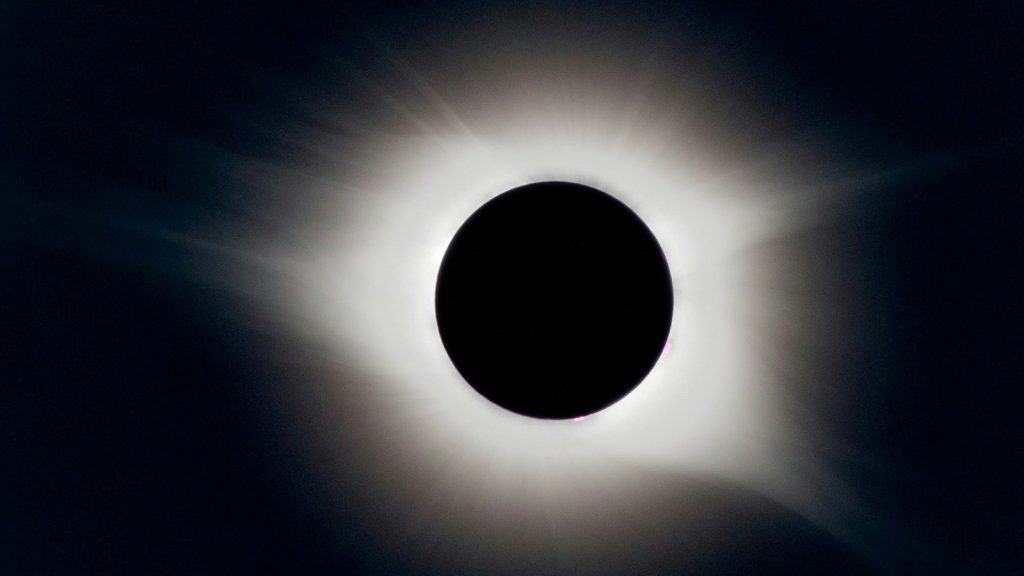
For about a minute on the evening of Wednesday, August 12, daylight drained out of northern Spain as the Moon slid fully across the Sun. Millions of people stood on hilltops, beaches and city squares to watch the country’s first total solar eclipse in more than a century — and, unlike much of Iceland a little earlier, most of them got a clear view.
A narrow shadow across the North Atlantic
The path of totality, roughly 294 kilometres wide, began over a remote corner of north-eastern Russia, crossed eastern Greenland, swept over western Iceland and then arced across northern Spain before ending over the Mediterranean. Outside that band, observers in the United Kingdom and parts of North America saw a partial eclipse; crowds gathered at England’s Jodrell Bank Observatory to watch the Sun turn into a crescent.
The longest totality anywhere on the track, 2 minutes and 18 seconds, fell over Breiðafjörður Bay in Iceland. The longest on land was 2 minutes 13 seconds at Látrabjarg in the Westfjords, while Reykjavík received about a minute. In Spain the Sun was already low: totality lasted around a minute and three-quarters near León and closer to a minute further east, with the shadow reaching the Balearic Islands just before sunset.
Spain: heat, crowds and empty pharmacy shelves
Spanish authorities had expected at least 500,000 additional visitors and prepared about 350 official viewing sites. The Interior Ministry deployed more than 33,500 police and civil guard officers. Many pharmacies sold out of certified eclipse glasses days in advance.
Viewers gathered in places such as the Roman-era hilltop town of Medinaceli, Berlanga de Duero in central Spain and the beach at Puerto de Sagunto near Valencia. Temperatures topped 35°C in many viewing areas, weeks after the most destructive wildfire in Spain’s history burned some 500 square kilometres around Ávila.
“It’s simply impossible to imagine,” Rosa Celiberti, a language teacher watching in Medinaceli, told the Associated Press.
Iceland: clouds, cheers and $1,000 hotel rooms
Iceland had the longest totality but the worst luck with the weather. Dense cloud covered much of the island and observers reported rain in places such as Grundarfjörður. Even so, hundreds of people in Reykjavík cheered as the sky went dark. Where gaps opened, watchers saw the solar corona, Baily’s beads and the “diamond ring” flash that marks the edges of totality.
Demand for rooms was intense: hotel rates in the capital averaged more than $1,000 for the night, roughly double 2025 levels, and authorities had prepared for up to 20,000 extra overseas visitors. Steinþór Jónsson, owner of Hotel Keflavík, said it was the biggest event at his hotel since the 1986 Reagan–Gorbachev summit.
What scientists were watching
A total eclipse is one of the few times the Sun’s faint outer atmosphere, the corona, can be studied from the ground without specialised instruments. Ahead of the event, Predictive Science Inc. ran a live forecast of the corona’s shape using near-real-time measurements of the Sun’s surface magnetic field. Its highest-resolution model yet extended from the solar atmosphere out to Earth’s orbit and included predictions for spacecraft such as Parker Solar Probe, Solar Orbiter, PUNCH and STEREO-A. NASA, the European Space Agency and the Virtual Telescope Project streamed the eclipse live.
Comparing those forecasts with photographs taken under clear Spanish skies helps researchers test how well models capture the magnetic structure that drives the solar wind — the stream of particles behind space weather that can disrupt satellites and power grids.
When is the next one?
Europe does not have long to wait. Another total solar eclipse on August 2, 2027 will cross southern Spain and North Africa, including Egypt, with one of the longest totalities of the century. A further total eclipse in 2028 will be visible from Australia and New Zealand.
For anyone planning to watch, the safety rule does not change: look at the partial phases only through certified solar filters, and remove them only during the brief moments of totality.