
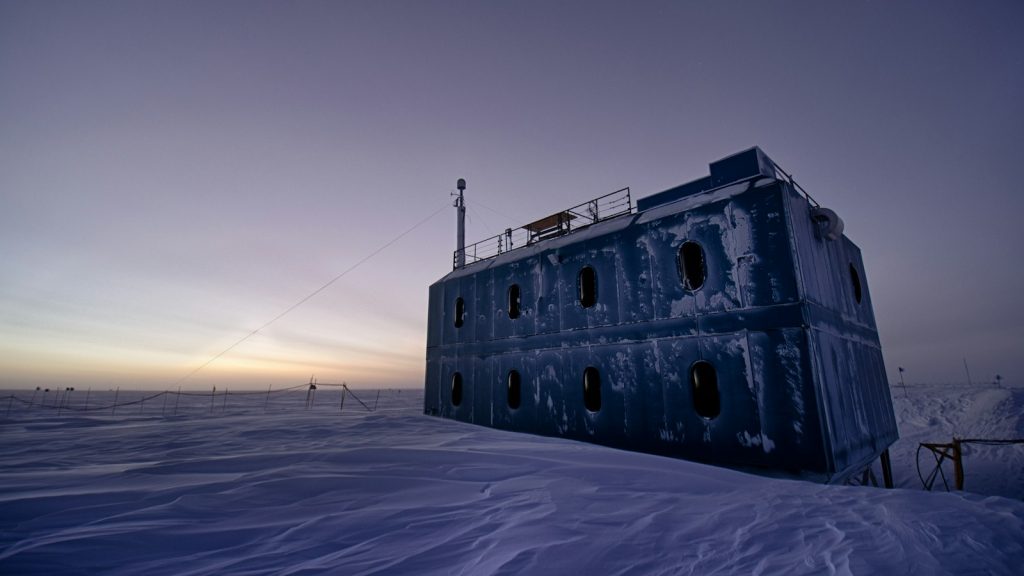
Two of this year’s science Nobel Prizes honour work that began as basic curiosity and grew into fields of its own: catching ghostly particles from deep space in the Antarctic ice, and understanding why nature so often prefers one “hand” of a molecule over its mirror image.
Physics: Francis Halzen and the IceCube Neutrino Observatory
The Royal Swedish Academy of Sciences awarded the 2026 Nobel Prize in Physics on Tuesday, October 6, to Francis Halzen, a Belgian-born physicist at the University of Wisconsin–Madison, “for decisive contributions to the IceCube Neutrino Observatory” and “the discovery of high-energy neutrinos of astrophysical origin.”
Neutrinos are among the most abundant particles in the universe, yet they barely interact with matter — trillions pass through your body every second without a trace. That makes them extremely hard to detect, but also uniquely valuable: because they travel in straight lines without being absorbed or deflected, they carry information directly from the most violent places in the cosmos.
IceCube, at the US Amundsen–Scott South Pole Station, turns a cubic kilometre of Antarctic ice into a detector. Thousands of light sensors frozen deep in the ice record the faint flashes produced on the rare occasions a neutrino collides with an atom. Halzen championed the project for decades. In 2013 the collaboration reported the first evidence of high-energy neutrinos from beyond our galaxy, opening a new window on the universe known as neutrino astronomy.
Chemistry: Henri Kagan and Kenso Soai
On Wednesday, October 7, the chemistry prize went to Henri Kagan of France and Kenso Soai of Japan “for the discovery of non-linear effects and autocatalysis in asymmetric organic synthesis.”
“This is about foundational chemistry,” said Heiner Linke, chair of the Nobel Committee for Chemistry. Many molecules exist in two mirror-image forms, like a left and a right hand. These are called chiral, from the Greek word for hand. The two forms can behave very differently in the body: one version of a drug may heal while its mirror image is inactive or harmful.
Kagan showed that the purity of a chiral catalyst does not translate into the product in a simple, linear way — a slightly impure catalyst can still produce a highly pure product, or vice versa. These “non-linear effects” changed how chemists design catalysts. Soai discovered a reaction in which a chiral product catalyses its own formation, amplifying a tiny initial imbalance into an almost pure single-handed product. His work offers clues to one of science’s oldest puzzles: why the molecules of life, such as amino acids and sugars, almost all share the same handedness.
The prizes
Each prize carries 12 million Swedish kronor (about $1.2 million), shared among the laureates in each field. The laureates will receive their medals from King Carl XVI Gustaf in Stockholm on December 10, the anniversary of Alfred Nobel’s death.